How to Rank in Google AI Overviews: Start With a Page That Already Ranks

Google's own answer to how to rank in Google AI Overviews is shorter than most of the advice written about it. Its page on AI features says there are "no additional requirements to appear in AI Overviews or AI Mode, nor other special optimizations necessary," and that a page can be shown as a supporting link if it's indexed and eligible to appear in Search with a snippet. When Google introduced its optimization guide in May 2026, it settled the label question as well. The guide says that optimizing for generative AI search "is optimizing for the search experience, and thus still SEO."
That doesn't make the work trivial. The pages that get cited tend to rank for the query or for the related questions Google's system goes looking for, to sit on sites the rest of the web talks about, and to say something only their owner could. The plan at the end of this guide applies that to one page you already have, and the sections before it explain why each step is there. Nobody can promise the citation itself, and Google says no third-party tool has access to its internal ranking or AI systems.
What makes a page eligible, and what quietly blocks it
Eligibility has three parts: the page is indexed, it's allowed to show a snippet, and the site is included in Search generative AI features in Search Console, which is the default. Google's page on AI features adds the technical basics: crawling has to be allowed in robots.txt and by any CDN or hosting infrastructure, important content should be available in textual form, structured data has to match the visible text on the page, and Merchant Center and Business Profile information should be up-to-date. Its optimization guide separately says that using Merchant Center and Google Business Profiles can help products and services stay visible in AI responses. Even then, Google doesn't guarantee that a page gets crawled, indexed or served.
The quiet blockers are settings, and a theme, a plugin or an earlier decision can leave one in place without anyone noticing. These are the controls Google documents, and each one works at a different level:
| Control | Where it's set | What it changes |
|---|---|---|
| nosnippet data-nosnippet max-snippet | Page HTML | Limits the text Google shows from the page, in AI features as well as regular snippets |
| noindex | Page HTML | Keeps the page out of Google Search entirely |
| Search generative AI | Search Console | Includes or excludes a property's links and content in AI Overviews, AI Mode and generative AI features in Discover |
| Google-Extended | robots.txt | Limits AI training and grounding in some of Google's other systems |
The Search Console setting is the bluntest of the four. Its help page says excluding a site means no traffic or impressions from those features, while other sites' content stays available and may look similar to yours. It isn't a ranking signal for the rest of Search, doesn't affect AI training, and generally takes a few days to apply. If none of these is set by accident, the page is eligible, and being chosen is a separate process.
How AI Overviews choose the pages they link
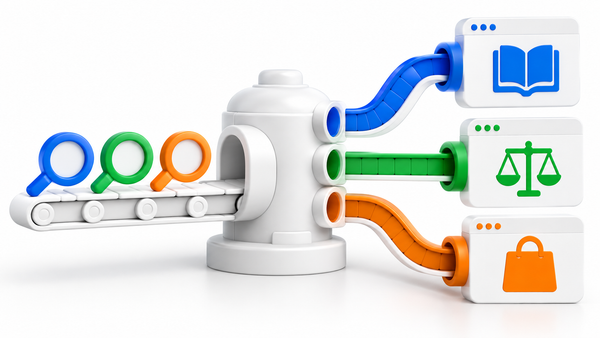
Google's guide describes two techniques. Retrieval-augmented generation, also called grounding, uses Google's core ranking systems to retrieve pages from the Search index and then writes a response that links to the pages supporting it. Query fan-out is "a set of concurrent, related queries generated by the model" to fetch more results.
Google's own example shows why a page that ranks well can still miss the answer. A search for "how to fix a lawn that's full of weeds" fans out into queries such as "best herbicides for lawns" and "remove weeds without chemicals," so the overview can be assembled from pages that rank for those questions rather than for the original one. A lawn-care guide that ranks first but never discusses herbicides or chemical-free removal gives the overview less reason to link it.
AI Overviews appear only when Google's systems decide they're additive to classic results, while AI Mode is meant for exploration and comparisons, and Google says the two "may use different models and techniques," so their links vary. Ahrefs describes AI Overviews as non-deterministic, changing with each refresh along with the URLs they cite. A screenshot of one overview is a sample rather than a standing, which is worth remembering when someone sells you a shortcut.
The tactics Google says you can skip
Google's guide lists things its Search systems don't need, and it's worth reading before you pay for an "AI Overview optimization" package:
- llms.txt files and other "special" markup. Google Search doesn't use them.
- Chunking content into tiny pieces. Google's systems understand several topics on one page, and there's "no ideal page length."
- Rewriting pages just for AI. Its systems understand synonyms and general meaning.
- Seeking inauthentic mentions. Core systems focus on quality, other systems block spam, and AI features depend on both.
- Overfocusing on structured data. It isn't required for AI features, though it still helps with rich results. Ahrefs says the jury is still out on schema, so I'd keep it where it's already good practice and not add it for AI Overviews alone.
One warning outweighs the rest. Creating separate pages for every query variation or fan-out query "primarily to manipulate rankings or generative AI responses" violates Google's scaled content abuse policy. Answering the surrounding questions on one useful page is a different thing from publishing a thin page for each, and if a vendor claims a method that beats this, ask for the methods and dates behind its results, as you would when you check an SEO case study.
What the studies say about AI Overview ranking factors
Google hasn't published AI-specific ranking factors; it says AI features rest on its core ranking and quality systems. The lists that circulate come from correlation studies, which measure patterns in the results rather than Google's systems, and four of their findings are useful for deciding where to spend time. Our generative engine optimization tips cover how the overlapping AI search terms relate.
The first finding is where overviews show up. Ahrefs analyzed 146 million search results pages and found AI Overviews on 21% of keywords, 57.9% of question queries and 46.4% of queries with seven or more words. Pew Research Center, working from the March 2025 browsing data of 900 U.S. adults, found an AI summary on 18% of searches and on 60% of searches that began with a question word. Both point at question-shaped searches, which is where how-to and explainer pages already compete.
The second is how much ranking for the exact query explains.
76% in July 2025 against about 38% in March 2026
Those are the shares of AI Overview citations that Ahrefs found ranking in the top 10: 76% in its first study of 1.9 million citations, and about 38% in an update covering 4 million AI Overview URLs. Ahrefs says its parsing improved between the two, so the drop isn't a clean trend, but ranking for the exact query explains fewer citations than it once seemed to.
The third is fan-out. Joshua Hardwick, researching with Surfer and reported by Ahrefs, found that pages ranking across fan-out queries were 161% more likely to be cited than pages ranking only for the primary term, with a Spearman correlation of 0.77 between the two. Page length barely registered, with Ahrefs reporting a near-zero correlation, about 0.04, between word count and citations.
The fourth is reputation off your own site. In a study of 75,000 brands, Ahrefs found that branded web mentions correlated at 0.664 with AI Overview brand visibility, against 0.218 for backlinks. The fair objection is that this is correlation, from a sample limited to sites above 40 on Ahrefs' Domain Rating (a third-party metric, not a Google one), and much-discussed brands have other strengths too. It does fit Google's note that AI features can show "what's being said about products and services across the web."
For most small businesses, the realistic way to be talked about is to be quoted, in a trade publication or a local news story that names the business for the topic. Answering journalist requests is one route, and it's the part of the work Backlinker AI takes on: it finds relevant reporter requests and drafts tailored responses from your expert's biography, so nobody on your team has to chase each opportunity by hand. The publication still decides what runs, and you should check that any quote under your name says what your expert would say. Before you change a page, decide how you'll know whether anything changed.
How to measure a citation, its accuracy and the clicks
Three different results get blended into the word "ranking," and each has its own check.
The citation is the easiest to count. Search Console's Generative AI performance report, which Google rolled out to all websites as of August 31, 2026, shows impressions from AI Overviews and AI Mode by page, country, date and device. Those impressions are also counted in the main Performance report under the Web search type, so don't add the two totals together.
Accuracy has no report. Read the overview for the main query and for two or three surrounding questions, note the date and the links, and check whether the answer reflects what your page says and whether the link beside it is yours. Keep that log dated, because overviews change between refreshes.
Clicks need realistic expectations. In Pew's data, users who saw an AI summary clicked a traditional result on 8% of visits, against 15% when no summary appeared, and clicked a link inside the summary on 1% of visits. Google says clicks from results pages with AI Overviews are "higher quality," with visitors more likely to spend time on the site. Both can be true for different sites, so track the inquiries and conversions a page produces, not sessions alone.
Date the off-site work as well. If Backlinker runs your journalist outreach, its monthly progress reports give you dates to set beside the Generative AI report, though a placement and a rise in impressions in the same month don't show that one caused the other. If a mention exists but your SEO tools don't list it, our guide to why SEO tools miss backlinks explains the usual reasons. With the measures settled, the work itself fits on one page.
A page-level plan for one page that already ranks
I'd start with a page that already ranks on page one for a question-style query that shows an AI Overview, because it has already cleared the retrieval step. Then work through it in this order:
- Confirm the page can be quoted. Use URL Inspection in Search Console to confirm the page is indexed, and check the HTML Googlebot received for any
nosnippet,data-nosnippetor tightmax-snippetrule a theme or plugin added. Then open Settings > Search generative AI and make sure the property is set to include, or inherits include from its parent. - List the questions around the query. Write down the five to eight questions a reader asks next, drawn from the overview itself, the People Also Ask box and your customer emails. For Google's lawn example, that might mean herbicides, chemical-free removal, timing and cost.
- Answer them on the same page. Give each question a clear heading and a direct answer in its first sentence or two. That's the plain organization Google describes for readers, not chunking for machines, and it avoids the page-per-variation problem.
- Add what only your business knows. Google's guide says content people find "unique, compelling, and useful" will likely influence a site's presence in generative AI search "in the long run more than any of the other suggestions in this guide," and its May 2025 advice made the same case for unique content supported by good images and video. Your own price ranges, the mistake your team sees most often and photos of your actual work are things a competitor can't copy.
- Earn one mention you didn't write. Look for coverage that would name the business for this topic, such as a local news quote or a trade article, and review whatever goes out under your name.
- Give the recrawl time. Google says recrawling can take from several days to several months, and you can request one after a meaningful change.
- Compare on a set date. Put the page's AI impressions, your dated read of the overview and the inquiries the page produced side by side, then decide whether the next page you'd treat the same way is worth the effort.
Sources
- Google Search Central, "AI features and your website," December 10, 2025. developers.google.com
- Google Search Central Blog, "A new resource for optimizing for generative AI in Google Search," May 15, 2026. developers.google.com
- Google Search Central, "Optimizing your website for generative AI features on Google Search," July 10, 2026. developers.google.com
- Search Console Help, "Search generative AI control." support.google.com
- Ahrefs, "How to Rank in AI Overviews: What Actually Works (Based on Data, Not Speculation)." ahrefs.com
- Pew Research Center, "Google users are less likely to click on links when an AI summary appears in the results," July 22, 2025. pewresearch.org
- Ahrefs, "Update: 38% of AI Overview Citations Pull From The Top 10," March 2026. ahrefs.com
- Ahrefs, "An Analysis of AI Overview Brand Visibility Factors (75K Brands Studied)," May 2025. ahrefs.com
- Backlinker AI, home page and Pro plan. backlinker.ai
- Search Console Help, "Generative AI performance report (Search)." support.google.com
- Google Search Central Blog, "Top ways to ensure your content performs well in Google's AI experiences on Search," May 21, 2025. developers.google.com